
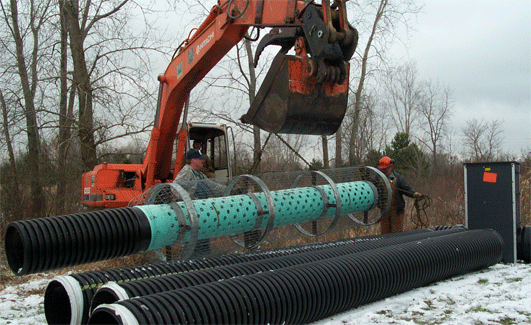
Beaver bypass at the Mud Lake Outlet Drain
Managing drainage in a rapidly suburbanizing watershed like that of the Mud Lake Outlet Drain is a challenge under the best of circumstances. Add the variable of a newly resident beaver population, and the challenge becomes even greater.
The Ingham County Drain Commissioner partnered with the Michigan Wildlife Habitat Foundation to find a way to manage drainage in just this situation.
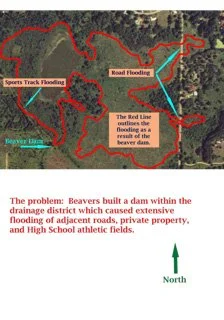
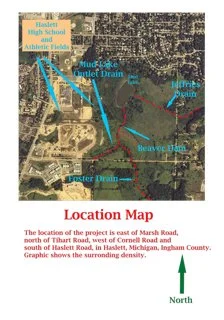
The problems started when beavers moved into part of Mud Lake, located on the Haslett High School property, and built a dam on the Mud Lake Outlet Drain. Water backed up a 1/2 mile from the dam, re-flooding a 150-acre wetland complex that had been partially drained for years. While many functional values of the wetland complex for water quality and wildlife were enhanced, the flooding was threatening athletic facilities at the high school, as well as nearby private property and public roads. The typical response to this problem would have been to exterminate or remove the beavers and remove the dam.
In some situations, in fact, that may be the only available or reasonable recourse. However, because of the location of the wetland complex, the beaver population, and the dam on school-owned property that was used primarily as open space, and the willingness of the school district to try to keep the beavers in the ecosystem; other options became available and more attractive.
The solution lay in managing the water level at a designed elevation that prevented unwanted flooding of private and public properties and facilities, while still providing sufficient flooding for the beavers and the wetland enhancements. The Ingham County Drain Commissioner partnered with the Wildlife Habitat Foundation to provide just such a solution.
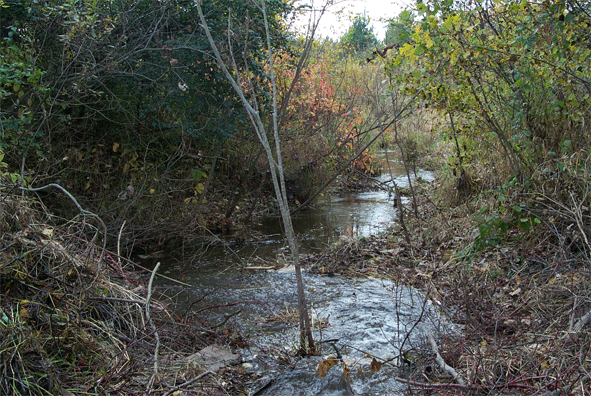
A number of issues had to be addressed for a workable solution. First and foremost, water levels had to be under the control of the Drain Office, not the beavers. An inline weir, often used for lake/pond water level management, provided this control. When the athletic fields and the track needed to be dry or the water flow needed to accommodate spring runoff, the weir could be opened in 4-inch increments to allow free flow of the water. At other times, water levels could be impounded to provide additional benefits for wildlife, water quality, and watershed management.
This weir was placed in the stream bank, and an 18 inch pipe, sized to accommodate the base flow and discharge of this drain, connected the weir to an inlet upstream of the dam and an outlet downstream of the dam. Effectively, the weir, not the dam, would set water levels. Nonetheless, the water still flowing into the inlet structure upstream of the dam would have likely triggered the beaver’s instinct to dam water. The two factors that trigger this response are detecting current flow or hearing trickling water. The addition of one other structure to this system therefore was needed to effectively “fool” the beaver into not detecting current flow or the trickling of water. A Clemson Beaver Pond Leveler is a device that has been used throughout the country to do just that.
It is an inlet device for water movement that essentially has so many inlet holes, that the flow is not detected by the beavers. However, these devices have largely been tested and employed in less urban situations. The discharges in this outlet drain necessitated some modifications to accommodate the greater base and maximum flows. The modifications included making the basic Clemson Beaver Pond Leveler: 1) longer--16 foot long; 2) wider--18-inch PVC pipe; 3) more reinforced--surrounded by galvanized wire mesh and steel bands, then anchored with rebar rods; and 4) more complex--routing the water flow through the leveler then through pipes and a weir instead of placing the leveler directly in the dam.
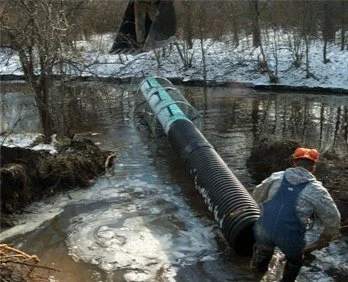
The weir, pipe, and modified Clemson Beaver Pond Leveler were placed in the Mud Lake Outlet Drain in November of 2000. In this first year, the structures have been virtually maintenance-free and have allowed for seamless adjustments to water levels throughout the seasonal flows. There have been no reports of flooding of private properties or roads since this project, and the high school has been able to use its athletic fields. Moreover, the beavers appear to have adjusted to the system well, and have yet to attempt to dam elsewhere or plug the outlet pipe. And, although only seen once by Drain Office personnel, there appears to be evidence that the population is thriving as many new trees are felled. The beavers continue to stay busy maintaining and improving their dam, which now is over 50% larger than a year ago, and reinforced with mud and stream sediment.
Monitoring the beavers as they modify their habitat continues to provide rich opportunities for the high school biology students’ study. To ensure a continued supply of preferred forage for the beavers so they wouldn’t move to another area along the drain, a tree-planting project was organized to include students from the high school and university to revegetate the water’s edge with aspens and willows. By all measures, this project is a resounding success that has demonstrated how effectively a watershed can be managed for water quality and quantity while working with, not against, nature.
Public Involvement and Public Education
The nature of the project and the need to prevent human/animal conflicts and encroachments which might drive the beavers away, public involvement had been kept to a minimum and mainly limited to education. However, a tree-planting project was organized which involved the public. Students from the local schools and Michigan State University, and adults from area service organizations assisted the Ingham County Drain Commissioner (ICDC) with planting 1000 aspens and 500 willows, preferred tree species for the beaver.
The project primarily has been valuable in broadening our understanding of coexistence with the beaver within essentially urban watersheds. During construction, the study of these beavers and how they modified the ecosystem was included in the biology classes at Haslett High School. Students documented changes in the trees and other plants within the wetland complex and monitored water quality in the Mud Lake Outlet Drain. Because this project has been in papers and presentations statewide and locally, there have been even broader opportunities for public outreach and education beyond the school setting.
Environmental and Water Quality Benefits
Historically, beavers were a natural part of the ecosystem in Ingham County. However, hunting and pressure from urbanization have reduced populations. The presence of beaver is now uncommon. Preserving beavers in the ecosystem is consistent with returning the drainageways to a more natural character, flow, and storage pattern while still managing the water for proper and necessary drainage. When the beavers built their dam, a wonderful opportunity was created for the ICDC to manage the water levels for environmental and water quality benefits. Like the beaver, the ICDC now manages the water to create new wetlands and enhance the functional value of the existing wetlands as well as impound the water behind the dam.
Many species of wildlife have already benefited from the presence of this dam and weir structure, including species such as waterfowl, frogs, salamanders, and turtles. The increase in wildlife diversity and numbers is only one benefit of creating water impoundments and wetlands though. In addition, there have been improvements to water quality. The water impoundment areas act as sediment basins and provide for the uptake of nutrients as water passes through the wetland vegetation. Since the Mud Lake Outlet Drain Drainage District is within a targeted Phase II area, these benefits will be even more critical as the township works to meet the requirements for compliance. Finally, like check dams on engineered watercourses, the beaver dam and water control structures have allowed for the moderation of flood flows on this drain, slowing the discharge.
Use Of New Materials & New Technology & Innovation
The materials used in this project are not new, however the way they were used in combination was novel. The design of the inlet, piping and weir to bypass the beaver dam and embedding the weir in the bank, aided in the successful “fooling” of the beavers and made for easier access to the weir. The project’s innovation was in its use of technology to work with nature to the benefit of water quality and water quantity management of the watershed.
Complexity
The project actually used very simple ideas, which in combination, made for a complex application. Projects such as this sometimes fail because the beaver is not successfully thwarted from detecting current flow or hearing trickling water. Much care was taken to engineer a system that would “trick” the beaver.
Cost-effectiveness
It was estimated that the removal of the dam and the extermination of the beaver could cost in the thousands of dollars annually, as recolonization of new beavers would be likely with the suitable habitat around the Mud Lake Outlet Drain. With the Michigan Wildlife Foundation’s donated expertise and materials, the solution chosen cost the Drainage District approximately $3,500 initially, and was estimated to cost less than $500 annually for maintenance. This solution was very cost-effective.

Awards Received
Michigan Association of County Drain Commissioners
Innovation and Excellence Award
Michigan Wildlife Habitat Foundation
Bengal Habitat Award
Charter Township of Meridian
Environmental Commission Environmental Stewardship Award